Silent Jungles
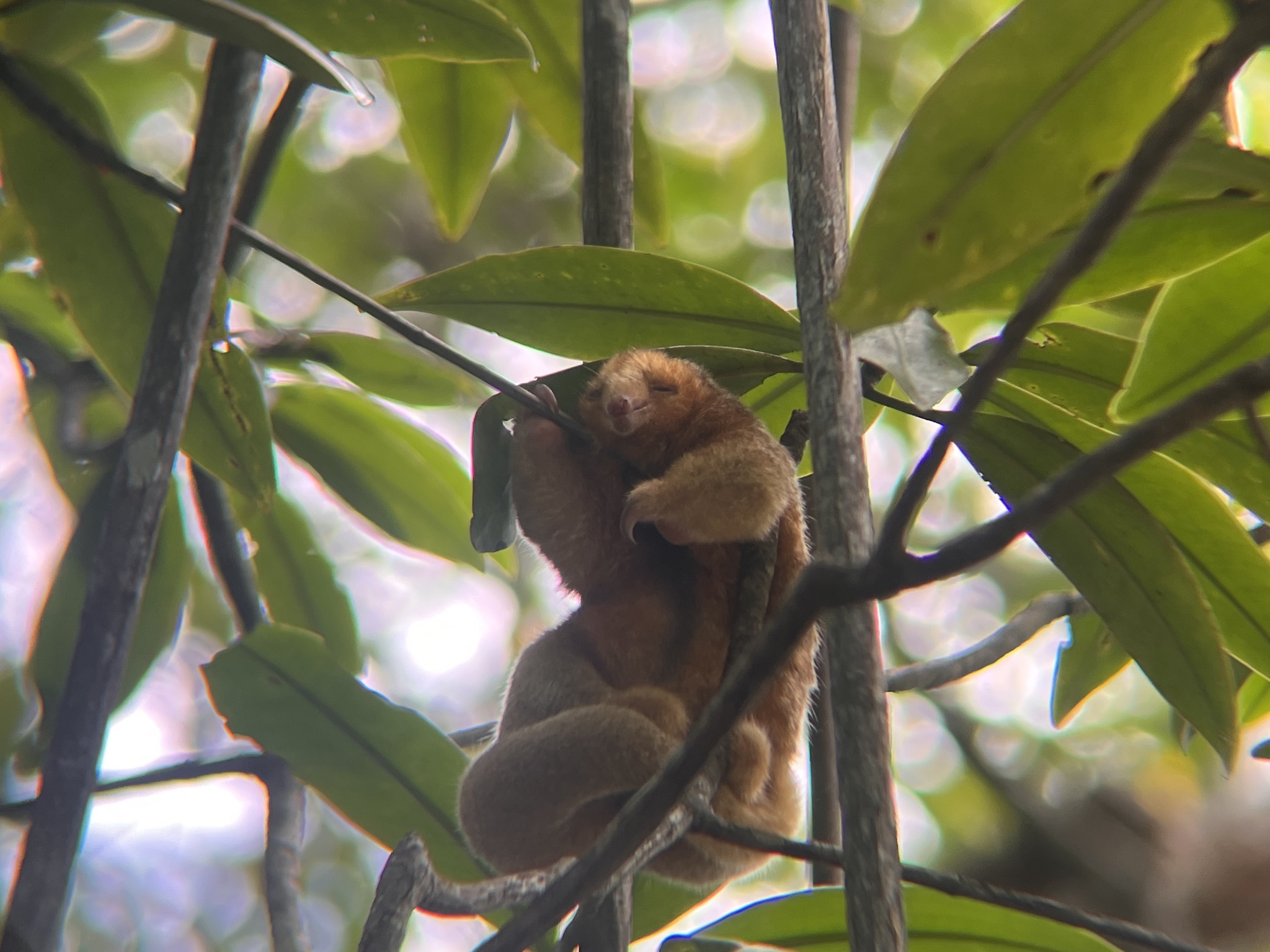
A Costa Rican silky anteater. Unrelated to the story. But look it up it’s cute.
In a Costa Rican Airbnb, I was reading on the bed when it suddenly gave a small but noticeable shake. You’d think a few years in the San Francisco Bay Area might tip you off in moments like this, but all I felt was confusion — the helpless kind, where you have no idea what’s happening nor even adrenaline to help.
“That was an earthquake,” my partner said, breaking the silence. “Did you notice the jungle got quiet?”
And indeed, the cacophony of frogs, cicadas, crickets, and all the other sounds you’d expect from an evening jungle were conspicuously absent for a few seconds, then simultaneously started up again like someone had pressed play on a “Jungle Focus” Spotify soundtrack. It was extremely obvious once pointed out.
It wasn’t obvious, however, exactly when this silence began.* It might have started a couple seconds before the shaking with the arrival of P-waves (as you remember from 8th grade Earth Science, of course). Compression waves that travel slightly faster than the more destructive, shear S-waves. In this case, based on the 12km distance to the epicenter and ChatGPT basic math my godly intellect, the jungle insects would’ve had ~1.4 seconds of lead time.
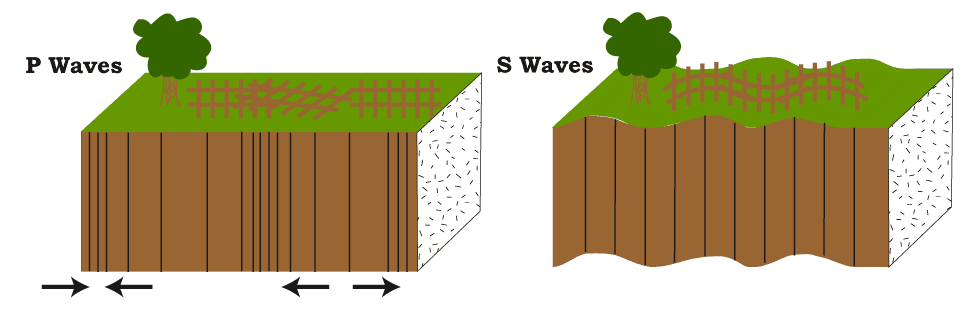
Some glorious MS Paint educational content. Source.
Ah, but of course, P-waves! That must be it. Humans rarely feel them, but how could you miss a compression wave if you’re a cricket living in the dirt? Yet, this is surprisingly debated. There’s plenty[0]The sixth sense of animals: an early warning system for earthquakes? MPG (2020) of[1]Can animals predict earthquakes? USGS anecdotal[2]r/AskLosAngeles post. Reddit (2021) reports[3]Did animals in Turkey, Syria sense the quake early? Washington Post (2023) of animals acting strangely before an earthquake. I did also find a video[4]Facebook video post. Big Island Thieves (2025) showing frogs going silent before a quake in Hawaii. However, a 2018 paper[5]Can animals predict earthquakes? Woith et al. (2018) surveyed 180 publications on animal earthquake prediction (including predictions days or weeks in advance, not just seconds), and wrote:
From a careful analysis of our database we find only very few cases where the P-wave arrival of the main-shock is a candidate to explain abnormal animal behavior.
Innocently titled Can animals predict earthquakes?, the paper could’ve been Stop Publishing Bad Earthquake Prediction Papers, You Fools. I ate some metaphorical popcorn while reading this academic takedown. From ants acting strange and building nests on fault lines, to fewer toads migrating to lakes, few studies had actually tried to explain the how behind these supposed signals. The authors gripe that most studies were based on single observations, weren’t reproducible, and had poor statistical analyses. They wrote:
For many of the reviewed case studies severe elementary problems are obvious […]
Ouch.
I spent a year in Berkeley living about 500 feet from the Hayward fault line, crossing it on my walk to the office. Sure would be nice if those earthquake prediction papers started to hold up to scientific scrutiny.
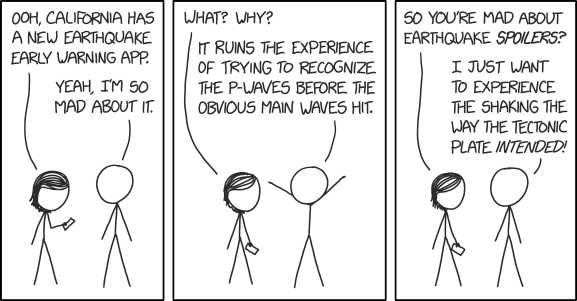
Special sensors can detect P-waves, at least — even if that only buys a few seconds. Source.
Solar eclipses are similar, in that odd behaviors are observed (in animals and humans alike), yet most are just (boring) reflections of what happens at night. Zoo animals head to their nighttime barns;[6]Zoo animals got quiet, exhibited nighttime behavior during total solar eclipse. CBS News (2024) birds fall silent as coyotes and nocturnal frogs pipe up.[7]Birds Went Silent during the Great North American Eclipse. Scientific American (2025) Dark means night, duh.
Earthquakes, on the other hand, are properly weird experiences. Although they aren’t exactly rare, reliable data are scarce.† Reports of odd animal behavior are often retrospective and partly explained by foreshocks, and most studies cover short time spans (< 1 year).
Still. Surprising we don’t have data on every animal movement, everywhere, over long time frames, to really figure this out, isn’t it?

Reading about animal-based earthquake prediction did feel like reading conspiracy theo—Forest Goes Silent When [Bigfoot] is Around,[8]Forest Goes Silent When Bf Is Around. The Bigfoot Forums (2015) posts a concerned member of bigfootforums.com.** They go on to paraphrase my next question: why is silence the universally preferred reaction across so many species? Not agitation or fleeing or something?
“I think it is a collective behavior associated with menace and I don’t think it is restricted to just bigfoot,” posts a follow-up. Fair enough. Like camouflage against visual predators, silence protects against acoustic ones. Prey adapt by going quiet, even when inopportune — like certain male moths or frogs that fall silent mid–mating display if they sense a bat nearby.[9,Adaptive Sounds and Silences: Acoustic Anti-Predator Strategies in Insects. Conner (2013)10]The Sounds of Silence as an Alarm Cue in Túngara Frogs. Dapper et al. (2010) Defensive silence has been observed in lots of species, like silver perch,[11]Sounds of sex and death in the sea: Bottlenose dolphin whistles suppress mating choruses of silver perch. Luczkovich et al. (2000) gulf toadfish, wolf spiders, katydids, and many more.[12]Tactics of evasion: strategies used by signallers to deter eavesdropping enemies. Bernal and Page (2022)
It is better to mate tomorrow than be eaten today.
I wrote this down from somewhere but couldn’t find the exact source when coming back to it.
What about the onset of silence: does everything fall quiet at once? Or does it propagate? It seems like the latter. A recent work[13]Small canopy species drive information highways about predators in an Amazonian rainforest. Camerlenghi et al. (2026) found that small canopy birds in the Amazonian rainforest are the primary spreaders of alarm calls, forming what the authors call “information highways.” Some birds propagate the alarm call, while most others fall silent; pretty cool, like a spreading droplet of quiet. The birds could even propagate alarm calls from other species, like primates.
The propagation of silence can be incredibly efficient, too. There’s a 2010 Biotropica paper that studied this in Central American túngara frogs,[10]The Sounds of Silence as an Alarm Cue in Túngara Frogs. Dapper et al. (2010) perhaps even the same species I heard in Costa Rica. They found that even a single frog that suddenly stops its calling can make an entire chorus of frogs go silent with “near simultaneity.” Crazy.
The 2026 conference for Biotropica, by the way, is held in Xishuangbanna: a tropical region in China rich in the biodiversity appreciated so deeply by the conference-goers. On my side of the street, AI conferences hit different — less tropical retreat, more climate-controlled monoculture around the latest hype.
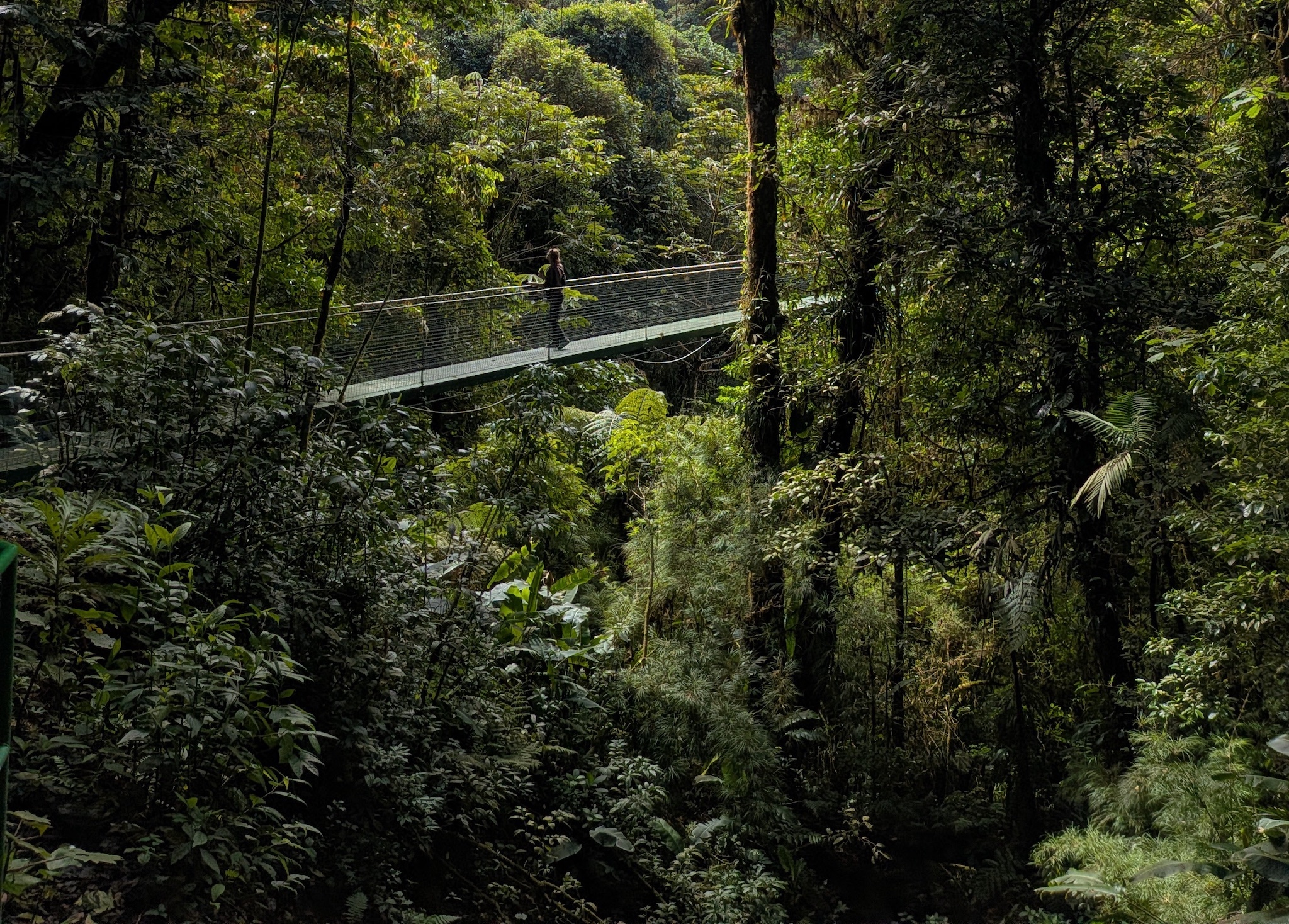
All the creatures waiting in fear and silence in the dark evening jungle remind me a bit of the Dark Forest from Liu Cixin's science fiction book (more literally than the author intended). A crowd where each is unaware of the other’s position, all silent to avoid being detected by an unknown power that could wipe them out. Of course there are differences when you are talking about hostile alien civilizations.
In any case, the 4.0 earthquake was no match for the hearty jungle, and the Costa Rican wildlife went back to normal within the minute. I, however, did not — last week I heard some frog croaking go silent by a lake and I braced myself for the invisible enemy.
Nothing happened, of course. Except Bigfoot walked by.
* Concerning, I know — missing a major precursor signal before a natural disaster does not speak well to my evolutionary path. ↩
† That's right, “data” is plural, specifically the second-declension neuter plural nominative form of “datum.” What good is 6 years of Latin if you can't be pretentious? ↩
** Actually, it was Forest Goes Silent When Bf Is Around. Initially I wondered what this boyfriend had done to be so widely feared by forest-kind. ↩
Citations
[0] The sixth sense of animals: an early warning system for earthquakes? MPG (2020)
[1] Can animals predict earthquakes? USGS
[2] r/AskLosAngeles post. Reddit (2021)
[3] Did animals in Turkey, Syria sense the quake early? Here's the science. Washington Post (2023)
[4] Facebook video post. Big Island Thieves (2025)
[5] Can animals predict earthquakes? Woith et al. (2018)
[6] Zoo animals got quiet, exhibited nighttime behavior during total solar eclipse. CBS News (2024)
[7] Birds Went Silent during the Great North American Eclipse—Here's What Researchers Discovered. Scientific American (2025)
[8] Forest Goes Silent When Bf Is Around. The Bigfoot Forums (2015)
[9] Adaptive Sounds and Silences: Acoustic Anti-Predator Strategies in Insects. Conner (2013)
[10] The Sounds of Silence as an Alarm Cue in Túngara Frogs, Physalaemus pustulosus. Dapper et al. (2010)
[11] Sounds of sex and death in the sea: Bottlenose dolphin whistles suppress mating choruses of silver perch. Luczkovich et al. (2000)
[12] Tactics of evasion: strategies used by signallers to deter eavesdropping enemies from exploiting communication systems. Bernal and Page (2022)
[13] Small canopy species drive information highways about predators in an Amazonian rainforest. Camerlenghi et al. (2026)